



TDEE (Total Daily Energy Expenditure) refers to the total amount of energy your body uses in one day (measured in kilocalories). Importantly, this energy use does not come from exercise alone. It includes everything from:
- breathing
- vital functions of the heart, brain, and internal organs
- everyday movement such as walking, standing, and general activity
- exercise, as well as digestion
In other words, even if you do not work out, your body continues to burn energy throughout the day and the sum of all that energy expenditure is called TDEE.
How Does Knowing Your TDEE Help?
Once you know your TDEE, you can plan your diet more accurately. For example:
- Eat at your TDEE → maintain your current weight
- Eat below your TDEE → lose weight and reduce body fat
- Eat above your TDEE → gain weight or support muscle growth
That’s why TDEE is often considered a key tool for achieving a fit body—without extreme restriction or starvation.
The 4 Key Components of TDEE You Should Know
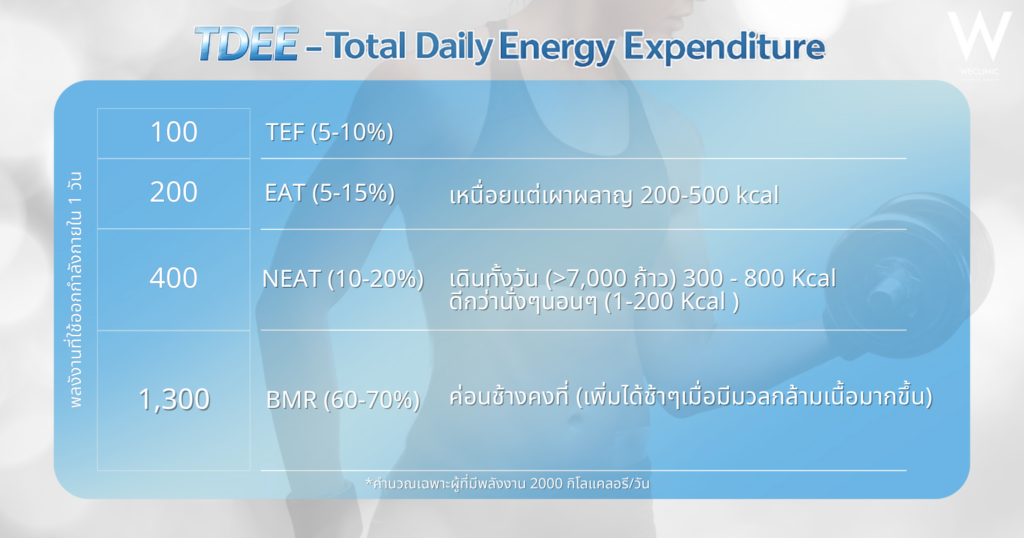
To truly understand how your metabolism works, it’s important to know what TDEE is made of. In general, TDEE comes from four main components:
1) BMR (Basal Metabolic Rate)
This is the baseline energy your body uses at rest—such as breathing, heartbeat, and brain function. BMR typically accounts for about 60–70% of TDEE, making it the largest foundation of your daily energy expenditure.
2) NEAT (Non-Exercise Activity Thermogenesis)
This is the energy you burn through daily activities that are not structured exercise—such as walking, standing at work, doing household chores, and general movement throughout the day.
NEAT is a key reason two people can eat the same amount yet have very different body shapes (one gaining weight more easily while the other stays lean).
3) EAT (Exercise Activity Thermogenesis)
This is the energy used during intentional exercise—such as strength training, running, swimming, or HIIT. While many people assume this is the most important factor, in the long run, BMR and NEAT often have a greater overall impact on TDEE.

4) TEF (Thermic Effect of Food)
This is the energy your body uses to digest and absorb nutrients. Protein, in particular, has a relatively high TEF—meaning that simply eating protein can slightly increase energy expenditure through the digestion process.
Why Is TDEE Important for People Who Exercise?
1) More precise body-shape control
When you know your TDEE, you can set your daily calories with a clear goal—whether that is maintaining weight, losing fat, or building muscle.
For example: if your TDEE is 2,500 kcal but you consume 2,000 kcal, you create a calorie deficit, which supports fat loss.
2) Better nutrition planning for your goal
Use TDEE as your baseline, then adjust your protein, carbohydrates, and fat to match your target whether it’s fat loss or muscle gain. This helps you eat with direction, not guesswork.
3) More effective training strategy
Understanding both energy from exercise (EAT) and daily movement (NEAT) helps you fine-tune your training volume and intensity and create a deficit without needing overly aggressive food restriction.
4) Improved recovery and real performance progress
If you burn a lot of energy but don’t eat enough, recovery can slow down and workouts may suffer. Knowing your TDEE helps you fuel your body appropriately so you have enough energy to train consistently and improve performance over time.
The Easiest Way to Calculate Your TDEE
Calculating TDEE can be broken down into two simple steps:
- Calculate your BMR
- Multiply your BMR by your activity level
1) Calculate BMR (Basal Metabolic Rate)
The most widely used and internationally accepted formula is the Mifflin–St Jeor equation.
For women: BMR = (10 × weight) + (6.25 × height) – (5 × age) – 161
For men: BMR = (10 × weight) + (6.25 × height) – (5 × age) + 5
Weight is calculated in kilograms (kg), height in centimeters (cm), and age in years.
2) Choose Your Activity Level
After calculating your BMR, the next step is to select the activity level that best matches your daily routine. This will give you the correct multiplier to estimate your TDEE.
| Activity Level | What it Means | Multiplier |
|---|---|---|
| Sedentary | Little to no exercise; mostly sitting (desk work) | 1.2 |
| Lightly active | Light exercise 1–3 days per week | 1.375 |
| Moderately active | Exercise 3–5 days per week | 1.55 |
| Very active | Hard exercise 6–7 days per week | 1.725 |
| Athlete / twice-a-day training | Very high activity; moving most of the day | 1.9 |
3) Multiply Your BMR by the Activity Multiplier = Your TDEE
TDEE = BMR × activity multiplier
This final number represents the actual amount of energy your body uses in a full day.
A Simple, Easy-to-Understand TDEE Calculation Example
Example (Female)
- Age: 27 years
- Height: 168 cm
- Weight: 65 kg
- Office-based job with little exercise → activity multiplier: 1.2
Step 1: Calculate BMR
BMR = (10 × 65) + (6.25 × 168) – (5 × 27) – 161
= 1,404 kcal
Step 2: Calculate TDEE
TDEE = 1,404 × 1.2
= 1,684 kcal/day (approximately)
This number represents the actual amount of energy your body uses each day.
Step 3: Monitor Results and Adjust Your Energy Intake

If you don’t want to rely solely on the number on the scale, you can assess whether you’re on the right track by looking at:
- Changes in body measurements, such as a reduced waist or hip circumference
- Before-and-after comparison photos
- Training logs being able to lift heavier weights often indicates improved strength
- Body composition measurements, such as body fat percentage from advanced tools (e.g., DEXA scans), to confirm whether body fat is decreasing
If your measurements decrease too quickly, it may indicate muscle loss—suggesting that your calorie intake is too low.
On the other hand, if measurements do not decrease and your weight increases or you feel bloated, it may mean that your calorie intake exceeds your actual energy needs, or that adjustments are required due to calculation variability.
Factors That Can Cause Inaccurate Energy Calculations
1) Underestimating or overestimating actual calorie intake
If portion sizes are not measured accurately, daily calorie intake can easily be underestimated or overestimated, leading to misleading results. Using proper weighing and measuring methods helps improve accuracy.
2) Misjudging activity level
Energy expenditure can vary significantly depending on daily movement and exercise intensity. For example:
- Being active and walking throughout the day vs. sitting at a computer most of the time
- Weight training for 30 minutes vs. training for 2 hours
Overestimating or underestimating activity levels can result in incorrect TDEE calculations.
Three Common Training Goals—and How to Use TDEE Correctly
1) If your goal is fat loss without losing muscle (Cut)
Aim to eat slightly below your TDEE.
→ Reduce 200–500 kcal from your TDEE.
Important caution: Avoid cutting calories too aggressively. Eating far below your needs can increase the risk of muscle loss, slow down your metabolism, disrupt hormones, cause fatigue, and impair recovery from exercise. As a result, fat loss may become unsustainable and rebound weight gain (yo-yo dieting) can occur more easily.
Example (TDEE = 1,684 kcal):
Recommended intake: 1,380–1,480 kcal/day
Expected result: Body fat gradually decreases while muscle mass is better preserved—your physique becomes noticeably more toned and defined.
2) If your goal is muscle gain without excessive fat gain (Lean Bulk)
Aim to eat slightly above your TDEE.
→ Add 200–500 kcal on top of your TDEE.
Example (TDEE = 1,684 kcal):
Recommended intake: 1,830–1,950 kcal/day
Expected result: Muscle mass increases, with minimal fat gain when training and nutrition are consistent.
3) If you are a beginner and want to lose fat while gaining muscle (Maintain)
This approach is especially suitable for body recomposition.
→ Eat at your TDEE (around 1,680 kcal/day), with a strong focus on protein, and train consistently.
- Prioritize adequate protein intake
- Strength train regularly
Expected result: Beginners often respond quickly, making it possible to build muscle and reduce body fat at the same time.

Summary
Knowing your TDEE can be a true turning point in body transformation because it helps you avoid unintentionally eating too many calories, and also prevents you from cutting calories too aggressively to the point where your body begins breaking down muscle mass.
With a clear TDEE number, you can set a more accurate daily intake, understand how much you should eat to match your goal, and then align that plan with your training both strength training and cardio in a structured, effective way.
References for TDEE
TDEECalculator.net. TDEE Calculator – Total Daily Energy Expenditure. https://tdeecalculator.net/
Mifflin MD, St Jeor ST. A new predictive equation for resting energy expenditure in healthy individuals. American Journal of Clinical Nutrition. 1990. https://pubmed.ncbi.nlm.nih.gov/2305711/
FAO/WHO/UNU. Human Energy Requirements: Report of a Joint Expert Consultation. Food and Agriculture Organization; 2004. https://www.fao.org/3/y5686e/y5686e00.htm


สำหรับผู้อ่านทุกท่านที่มีข้อสงสัยเพิ่มเติม ทีมแพทย์ We Clinic ยินดีให้คำปรึกษาฟรี
โดยไม่มีค่าใช้จ่าย หรือสามารถปรึกษาหมอทาง facebook หรือ Line ได้ที่นี่เลยครับ